
Huntsville Directory Runs and Repositories
Huntsville directory research starts with a broken series, not one complete shelf. The earliest verified volume is Williams' Huntsville Directory, City Guide and Business Mirror. Its city guide, resident list, trade classes, street directory, and post-office list make it much broader than a bare name index. A second free scan covers the late nineteenth century. Later evidence is split among scattered printed issues, telephone books, state archive holdings, and local library resources.
The gaps matter. The Alabama Department of Archives and History directory finding aid lists selected issues, but the run is discontinuous. Huntsville-Madison County Public Library does not publish a full shelf inventory, does not state the exact reverse-directory years, and will not answer city-directory questions by telephone. Confirm a volume in the catalog or with Special Collections, then plan to retrieve it in person.
| Collection | Verified years | Where held | Access |
|---|---|---|---|
| Williams' Huntsville directory | 1859-60 | Huntsville History Collection | Free 174-page scan |
| Huntsville City Directory | 1896-97 | Huntsville History Collection | Free 162-page scan |
| Surfaced city issues | 1908, 1911, 1913, 1927, 1929, 1931 | Genealogy and digital references | Varies by issue |
| Telephone directories | 1946-51, 1952-62, 1963-64, 1965-66, 1972-73 | Library of Congress | Digitized catalog |
| ADAH directory holdings | Selected issues from 1973 through 2006 | Alabama Archives | Finding aid and archive access |
The latest listed holding cannot be called the final printed issue. Likewise, no missing year should be treated as proof that Huntsville had no directory that year. It may only mean that no verified copy surfaced in the available inventories.
Open Huntsville City Directories Online
Two foundational volumes are free through the Huntsville History Collection. The 1859-60 Huntsville directory scan has 174 pages. The 1896-97 directory scan has 162. Downloading a full PDF makes it easier to check the title page, key, advertising pages, street list, and resident section together. Browser text search can miss old type, faint scans, initials, and split columns, so page-by-page review still earns its keep.
The Library of Congress also holds digitized telephone-book runs. Its 1965-66 Huntsville telephone directory helps bridge the postwar era. Telephone listings are not the same as a resident volume: a phone book may omit households without service or unlisted numbers, while a city volume may add occupations, spouses, firms, or civic material. Use the source that matches the claim.
Note: Optical text search is a lead, not a verdict; scan initials, spelling variants, married names, and nearby pages before ruling someone out.
Decode a Huntsville Directory Entry
An inspected page in the 1896-97 Huntsville directory shows compact lines with surname, given name, occupation or employer, and a work or home address. The marks h and r distinguish a house or home from a place where someone resided or roomed. Other common terms include wks for works, lab for laborer, dom for domestic, nr for near, cor for corner, and opp for opposite. “Same” means the residence and business address match.
Some entries also use Miss, Mrs., or widow language. The volume contains a period racial marker applied to Black residents. It reflects discriminatory publishing practice and must be understood in its historical setting, not reused as a modern identity label. Bold or black-letter names marked people who supported publication, which is another reason to read the key before assigning meaning to type style.
| Person | Surname, given name or initials, with marital or widow wording when supplied |
|---|---|
| Work | Occupation, employer, or a business address |
| Home | Street number or a relative phrase such as near, corner, opposite, or rear |
| Status marks | House, residence, rooms, or same address, as defined by that volume's key |
| Limits | No reliable modern birth date or parcel identifier |
- Criss-cross directory
- A later directory arranged by street address, allowing an address-to-occupant search instead of a name-to-address search.
- Householder index
- An address-oriented list of the person associated with a household at publication time, not proof of every person present.
- Abbreviation key
- The publisher's legend for shortened words and symbols. Read it before comparing entries across volumes.
Pair Huntsville Directories With Census
A directory offers a short annual or periodic snapshot. The federal census adds household names, ages, relationships, birthplaces, and occupations, but public schedules now stop at 1950 under the 72-year release rule. Using both is stronger than trusting either alone. Huntsville research documents Martha Bradford in the 1859 directory on the south side of Randolph. The 1860 census added her sons, ages, birthplaces, and property. Her husband's absence suggested widowhood, while the 1850 census supplied him and other children.
That example shows a sound sequence. Start from a directory address, compare the closest public census, and check whether names and occupations align. Treat an absence as a question. A person may have moved, died, been missed, used initials, changed a surname, or lived outside the publisher's canvass.
- Find the first alphabetical entry and copy its spelling, initials, trade, employer, and home wording.
- Expand each abbreviation with that volume's key, separating the work site from the home.
- Compare the next available directory issue for a move, new trade, marriage marker, or disappearance.
- Pair the address and household with the nearest public census through 1950.
- Close a broken trail with deeds, an estate file, an obituary reference, or cemetery evidence.
Huntsville Directory Help at HMCPL
Huntsville-Madison County Public Library is the key local access channel for Special Collections, newspapers, genealogy tools, and historical directory shelves. Contact Special Collections at 256-532-5969 or hhrdept@hmcpl.org. HeritageQuest provides census images and genealogy or local-history material in a branch without a card, or remotely with a library card and PIN.
The library also became part of a county records story. An earlier Madison County project put a Records Center on HMCPL's third floor under the Probate Judge and paired it with long-term digitization work. Current location and service must be confirmed before visiting. The useful lesson is practical: an online catalog may point to a volume, but staff, the physical shelf, microfilm, and county archive routes still matter when a digital search ends.
Insider tip. HMCPL does not provide city-directory information by telephone, so identify likely years first and plan for in-person volume use.
Extend Huntsville Directory Trails
When a name vanishes from a Huntsville directory, the HMCPL Obituary Index can search by deceased person, cemetery, or source newspaper. The index is free, while a photocopy request costs $5. Its inventory includes tens of thousands of Huntsville Times references plus Daily Times, Huntsville News, Weekly Democrat, and predecessor titles. An index entry points toward a notice; it is not the full obituary.
The Huntsville cemetery gateway can then add cemetery, block, lot, space, date, inscription, and map clues. Probate estates and deeds may explain what happened to property after a death. These sources support family history because they answer different questions: the directory locates a person at one snapshot, the notice links kin and life events, the burial record fixes a final place, and probate records address the estate.
Map Huntsville Directory Addresses
Names become more useful when placed on the old street. Library of Congress Sanborn sheets survive for Huntsville in December 1884, January 1888, March 1894, February 1898, June 1901, April 1908, December 1913, and March 1921. The digitized 1898 Huntsville map shows structure footprints, building use, materials, and changes between editions. It does not name every occupant.
Neighborhood age can guide the choice. Five Points grew from the 1892 East Huntsville Addition and entered the city in 1925. Old Town includes homes dating from 1828, with much of its fabric from 1880 through 1929. McThornmor Acres belongs to the 1956 aerospace and missile era. An early resident volume and Sanborn sheet suit an Old Town question; a postwar telephone book may fit McThornmor Acres much better.
Huntsville Lives in UAH Archives
The UAH ArchivesSpace catalog searches a term, operator, record type, field, and a range of years. Its 221 collections focus on aerospace, flight, science fiction, local politics, and Tennessee River Valley history. Subject filters include Huntsville, Redstone Arsenal, NASA, German American history, and George C. Marshall Space Flight Center. UAH also preserves oral histories tied to rocket science, Women in STEM, Thiokol, Army and Department of Defense work, university history, and community life.
Open the UAH archival search before reviewing the captured interface below.
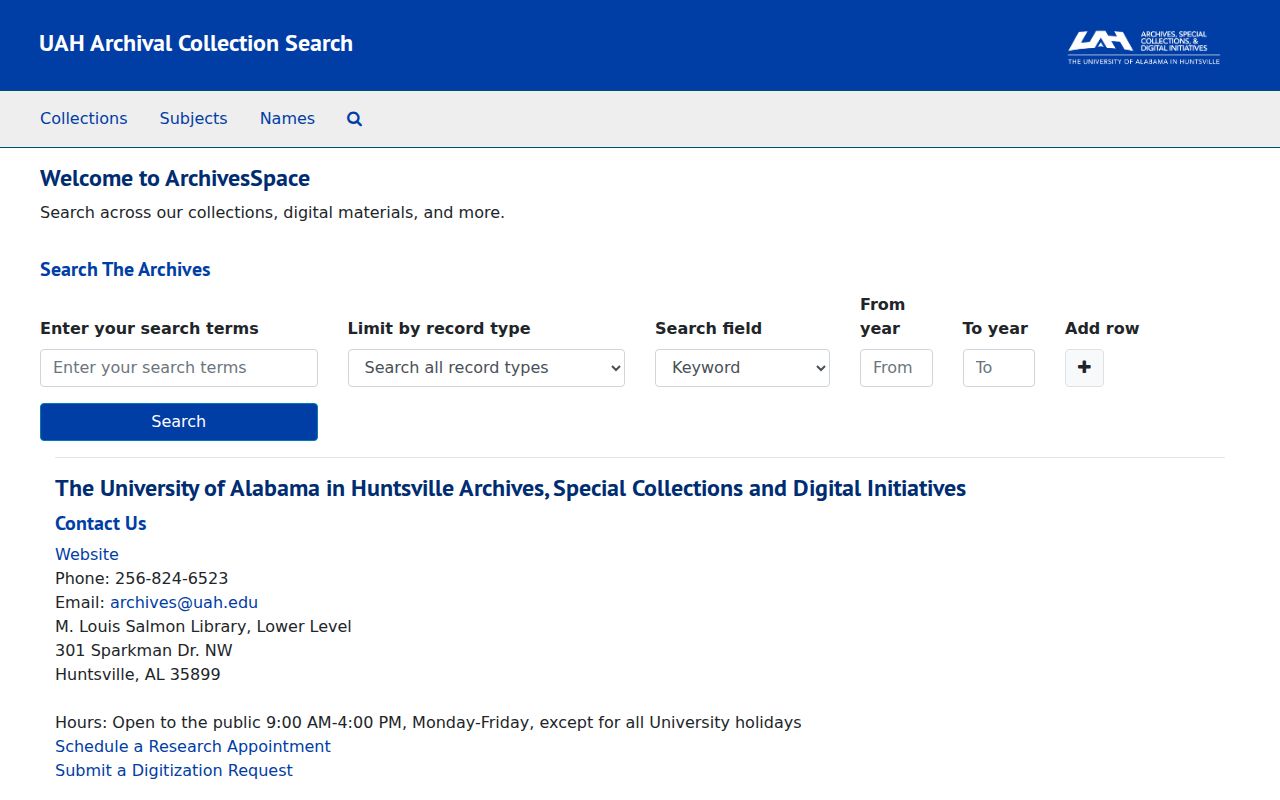
The search controls help narrow a directory name to a dated local collection, but an archival reference documents a career or community tie rather than a current address.
The archive is in the lower level of M. Louis Salmon Library at 301 Sparkman Drive NW. Listed hours are weekdays from 9 a.m. to 4 p.m.; appointments and digitization requests are available through 256-824-6523 or archives@uah.edu. The digital repository reports 8,242 items, yet catalog descriptions may still require a box request to see the underlying record.
Trace Family in Huntsville Directories
Huntsville directories trace change best when each claim stays modest. A listed address shows how the publisher recorded a person for that issue. It does not prove constant residence for the whole year. Occupation and employer can separate two people with the same initials, especially across the cotton, textile, military, and aerospace eras. Dallas Mill workforce and Merrimac Cemetery sources may help with mill families, while UAH papers and oral histories add depth to Space Race lives.
Keep a research log with the exact title, issue year, printed page, PDF page, spelling, symbols, and address. Then check the next earlier and later issues. If the trail shifts to a current parcel question, use the Huntsville street directory workflow instead of projecting a historic entry onto today's map.
| Milestone | Directory evidence |
|---|---|
| 1859-60 | First verified printed Huntsville directory |
| 1896-97 | Verified resident and civic volume with inspected entries |
| 1946 onward | Library of Congress telephone-book runs begin |
| Through 2006 | Latest named state-archive holding, not a proven final issue |
Note: Madison County does not appear on the Alabama Archives courthouse-fire list, so no destroyed-record gap should be invented to explain a missing name.