
Huntsville Previous-Resident Source Eras
A Huntsville address history is built in layers. The assessor fixes the present parcel and assessed owner. Deeds establish transfers of title. Directories and census schedules supply occupant evidence, while Sanborn maps show the building rather than the people. Permits may add change dates and an applicant or contractor, but they do not prove who slept at the address. Probate and obituaries often explain the end of an owner's or occupant's trail.
Choose by era and claim. For a recent transfer, begin with the parcel card and Probate instrument. For a nineteenth-century address, use deed books, city volumes, a census, and Sanborn sheets. For postwar Huntsville, telephone directories and archival sources may help track the sharp migration tied to Redstone Arsenal and NASA.
| Source | Years it covers | Where held | What it shows |
|---|---|---|---|
| Recorded-document system | Online cutoff not published | Madison County Probate portal | Instruments available after free account login |
| Historic land and probate books | Exact local start not stated | Probate appointment, request, or historic archive | Deeds, probate books, and older files |
| City directories | Verified 1859-60, 1896-97, selected later issues | HHC, HMCPL, ADAH, and LOC | Names, trades, firms, and addresses |
| Federal census | Public through 1950 | NARA and library databases | Household names, ages, relationships, and work |
| Sanborn maps | 1884, 1888, 1894, 1898, 1901, 1908, 1913, 1921 | Library of Congress | Building footprint, use, materials, and change |
| Permits | Online start not published | City GIS, Inspection, or records request | Building changes, applicant, or contractor |
No table row alone names all past residents. An owner is a title claim. A directory is a dated publisher snapshot. A census household is richer but only periodic. Build the chain from agreements among sources.
Start Huntsville Past Residents Today
Most Huntsville addresses begin in Madison County's AssuranceWeb property search. Address mode places the house number in the first search field and street text in the optional second field. Save the assessed owner, PIN, account, parcel, physical or situs address, billing or mailing address, exemption, and full subdivision or legal description. “Situs” means the parcel's physical location. A mailing address is where the owner receives notices and may be elsewhere.
Huntsville also extends into Limestone County and Morgan County. A Huntsville mailing line is not proof that Madison County holds the deed. Resolve the parcel and county first, especially on the western or southern edge. The city first reached Morgan County in 2018, so a present city address may have an older trail under a different jurisdiction.
Key distinction. Homestead status can support owner occupancy, but neither it nor the tax roll identifies every person who lived at the address.
Walk Back Huntsville Ownership
The Madison County Probate recorded-document portal requires a free account. The county says both account creation and documents available in the system are free. It does not publish a dependable earliest online year, so a broken web trail should lead to the office or historic archive rather than a made-up cutoff.
Open the Madison County deed portal to see the account gate captured below.
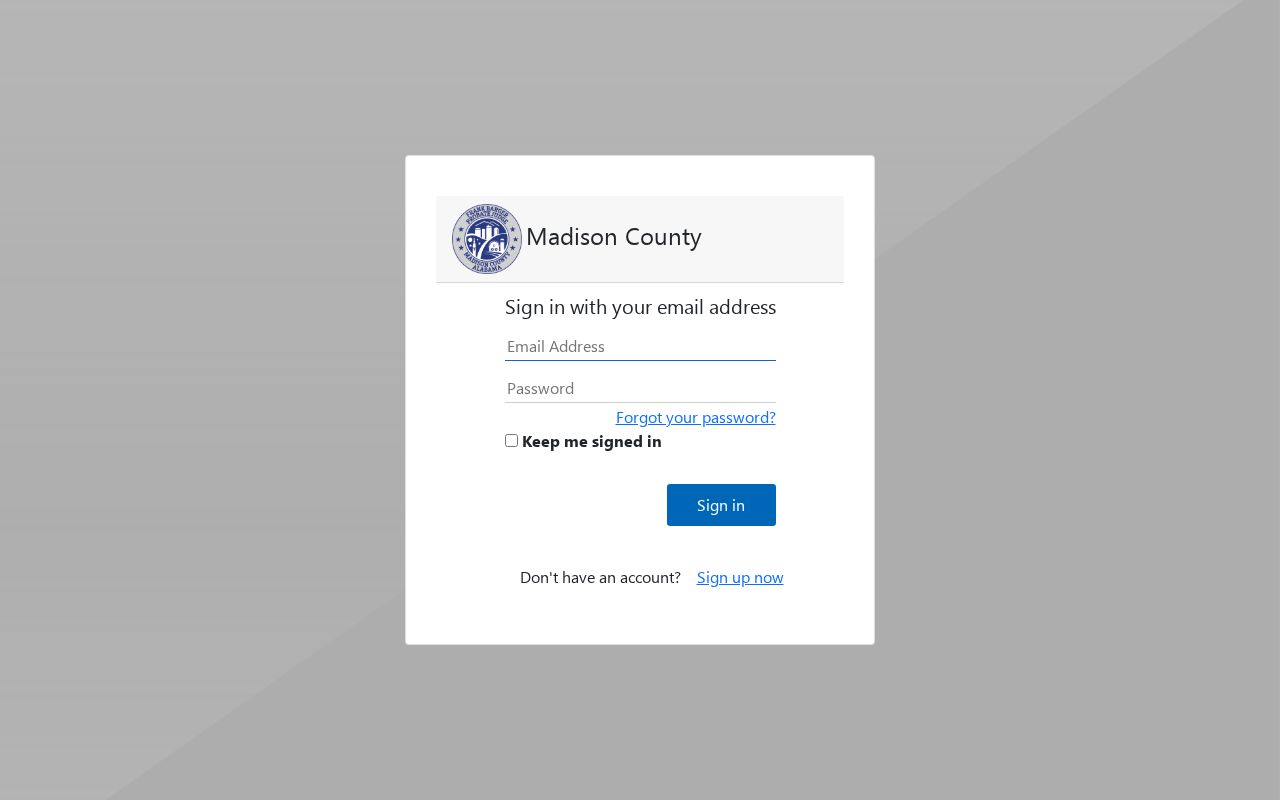
The login screen is only the first access channel; direct land-record use, email or mail delivery, and historic archive appointments remain available when an instrument is absent online.
- Copy the present owner, parcel identifiers, and complete legal description from the assessor result.
- Find that owner's acquisition deed by searching the person as grantee, the party who received title.
- Record the grantor, the party who gave title, plus the date, instrument or book-page reference, and legal description.
- Search that grantor as an earlier grantee, restricting the dates to before the later sale.
- Repeat only when the lot, block, subdivision, or metes-and-bounds description remains continuous.
- Grantor and grantee
- The grantor conveys an interest; the grantee receives it. Their roles reverse as a title chain moves backward.
- Chain of title
- The linked sequence of recorded transfers affecting the same land.
- Legal description
- The lot, block, subdivision, or boundary wording that identifies land more reliably than a changeable street number.
Huntsville Previous Residents Offline
When the portal stops, Madison County Probate provides several documented paths. Recording and Probate functions operate at the Madison County Service Center, 1918 Memorial Parkway NW. Direct land or court-record access requires an appointment at least one business day ahead. Electronic or U.S. mail delivery may be requested at 256-532-3330 or probate@madisoncountyal.gov.
The historic archive is at 6921 Highway 431 in Owens Cross Roads. Listed hours are Monday, Wednesday, and Friday from 9 a.m. to 3 p.m.; Tuesday and Thursday use the same hours by appointment. Copies follow the published Probate fee schedule, including $1 per page plus $2 for certification. Certification is useful when an official copy is needed, but a working house-history trail can begin with an ordinary copy.
Recorder fees also reveal a search trap. The base recording includes only the first two grantors, first two grantees, and two cross-references. Added aliases, former names, estates, trusts, representatives, and other variants are separately indexed. Try those forms when a prior resident's chain seems to end without a sale.
Pair Huntsville Residents Across Years
Deeds identify owners, not all previous residents. City directories can place a named person at an address and may add a trade, employer, spouse or widow marker. Later criss-cross volumes, when available, reverse the usual order and let an address lead to an occupant. HMCPL does not publish exact reverse-directory years and will not provide city-directory information by phone, so confirm likely volumes and use them in person.
The verified Huntsville series includes free scans from 1859-60 and 1896-97, scattered early twentieth-century issues, Library of Congress telephone books beginning in 1946, and discontinuous Alabama Archives holdings into 2006. The full collection detail belongs to the Huntsville city directory page; for address history, use only the volumes closest to a known deed or census date.
Address to household: normalize the old street wording, search the nearest directory issue, compare the next earlier and later issues, pair the names with the closest public census through 1950, then test the result against a deed, obituary, or probate file. A disappearance may mean a move, death, omission, spelling shift, or changed surname. It is not proof by itself.
Map Huntsville Past-Resident Clues
Sanborn fire-insurance maps date the built setting around an address. Huntsville editions survive for eight dates from 1884 through 1921. The 1898 Huntsville Sanborn sheets show footprints, use, materials, and changes between editions. They help test whether a structure existed and how a lot was arranged. They do not identify its occupants.
Permits and city GIS records can add build or alteration dates, an owner, applicant, or contractor. The local online starting date is not published, so the fallback is Huntsville Inspection, GIS, or a narrow City Clerk request. Do not turn an applicant into a resident without separate occupant evidence.
Annexation layers add another check. Huntsville GIS offers a combined layer for 1811-1949, decade layers from the 1950s through the 2020s, and individual 2025 and 2026 layers. Those dates help identify which government kept records when a place was outside the city.
Note: City-limit history and the legal description can preserve continuity when a postal label or street number no longer matches the older record.
Alabama Archives Fill Huntsville Gaps
The Alabama Department of Archives and History provides catalogs, county materials, historical government collections, and a city-directory finding aid. Its holdings are a strong fallback when a local shelf or web portal has a gap. Statewide FamilySearch collections identified in the Huntsville research add Alabama probate records for 1809-1985, estate files for 1830-1976, 442,506 Madison Chancery and Circuit images for 1829-1968, and Madison Circuit case files for 1825-1872.
Review the Alabama Archives search gateway shown in the captured image.
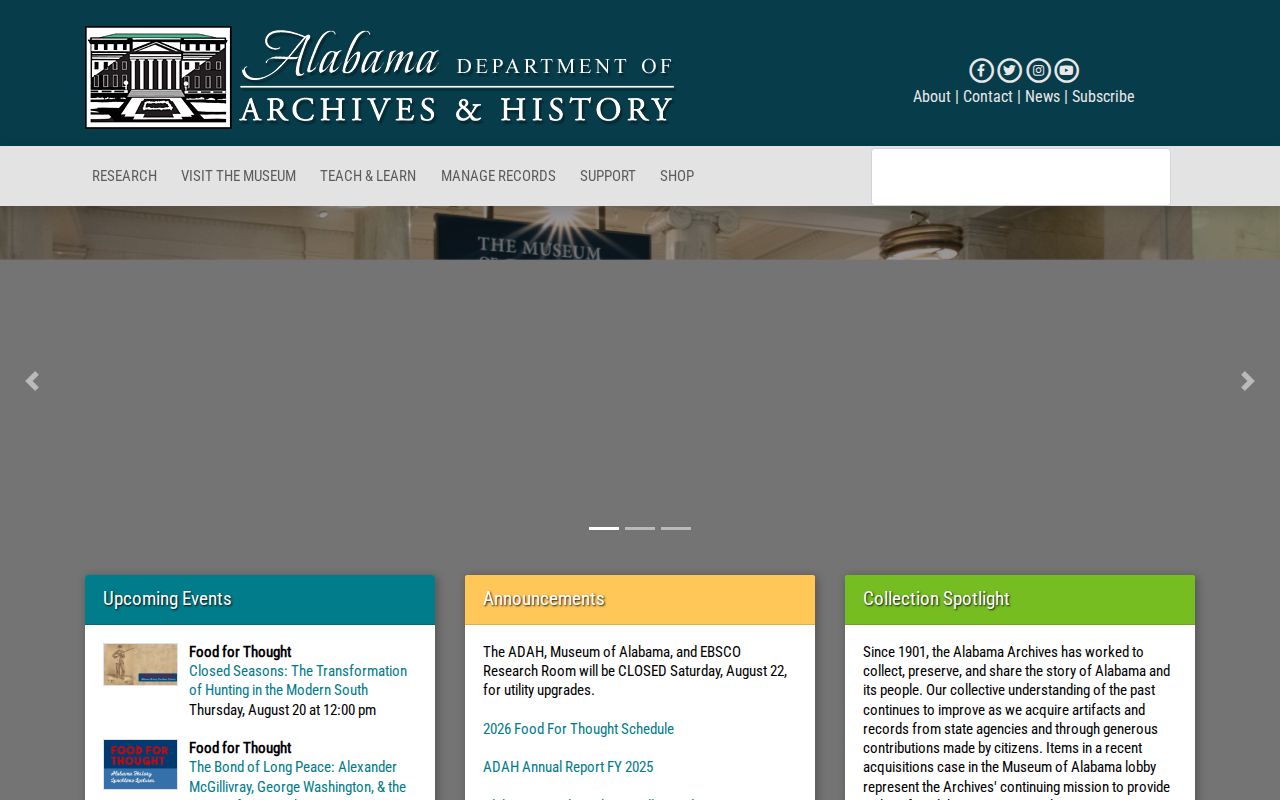
The archive catalog can point from a family name, county, or record group to material that is not available in the current deed portal.
Madison County is not listed on ADAH's official courthouse-fire list. Commercial fires damaged city blocks in the 1850s, but they do not establish a courthouse-record loss. Missing past residents should therefore prompt spelling, jurisdiction, indexing, and format checks before any claim that records were destroyed.
Close Huntsville Previous-Resident Trails
The HMCPL Obituary Index searches by deceased name, cemetery, or newspaper. Its index is free, and a photocopy costs $5. A notice may name relatives, a former street, church, employer, or burial place that separates two similar names. Probate may then identify a decedent, petitioner, heirs, estate property, or the sale that explains a later deed.
Open the HMCPL obituary index before using the search screen pictured below.
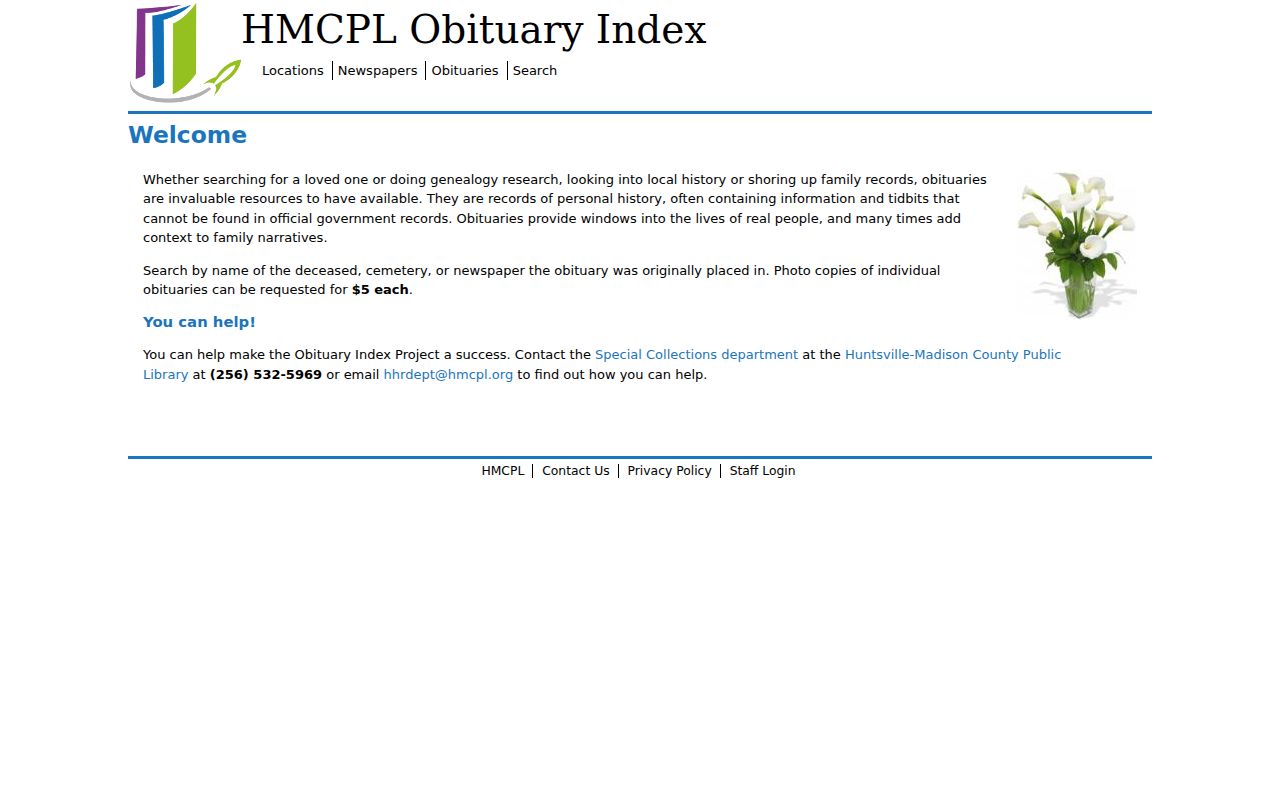
The visible name, cemetery, and newspaper routes provide several ways to test whether a person who left the address later died in the Huntsville area.
The library inventory contains 68,281 Huntsville Times references, 5,794 Daily Times references, 3,323 Huntsville News references, and 2,326 Weekly Democrat references, along with other predecessor titles. Those totals explain why an obituary index can bridge many directory gaps, but each result still needs the underlying notice.
Huntsville Addresses Follow Local Eras
The likely evidence changes by neighborhood and period. Five Points began with the 1892 East Huntsville Addition and was annexed in 1925, so early directories and Sanborn maps can be fruitful there. Old Town includes homes from 1828 and much building from 1880 through 1929. McThornmor Acres was developed in 1956 for the early aerospace and missile era, making postwar telephone directories, deeds, and permits a better fit.
Huntsville had 16,437 people in 1950 before the rocket-engineer influx reshaped the city. Antebellum trails lean on deeds, the 1859 directory, and census records. Textile-era questions can add Dallas Mill workforce and Merrimac Cemetery sources. Space Race research can move from telephone books into UAH archival papers and oral histories. Source choice should follow the place's actual age, not the oldest available record.
Use Past Huntsville Residents Lawfully
A defensible conclusion names the record and its limit. “Assessed owner” comes from the parcel roll. “Received title” comes from the deed. “Listed at the address” comes from a dated directory. “Enumerated in the household” comes from a census. Keeping those claims separate prevents an owner's mailing address, a permit applicant, or a map label from becoming false occupant evidence.
For living people, stop at what a lawful family-history or house-history purpose needs. Protected addresses and private utility customer records are not substitutes for a missing public source. Never publish intimate details merely because separate records can be joined.
Lawful use. Research Huntsville previous residents for family history, house history, estates, or personal curiosity, never to stalk, harass, or harm a living person.